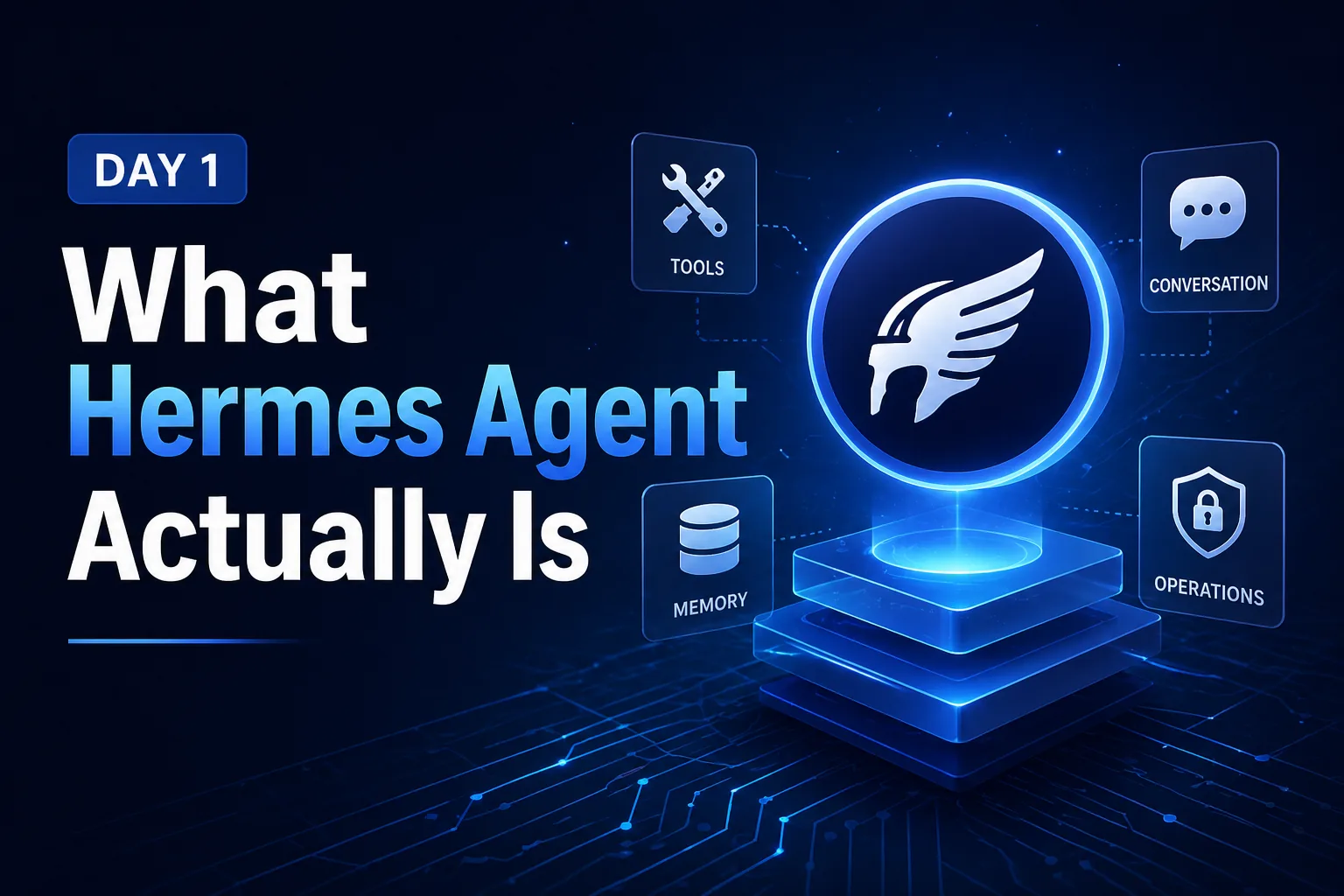
Hermes Agent 6-Hour Crash Course: Hour 1 - Mental Model and Setup
This crash course is designed for builders who want to understand Hermes Agent quickly without turning the first day into a large infrastructure project. In the first hour, the goal is to create a clear mental model, install only what is needed, and run one contained session that proves the loop works.
What Hermes Agent is
Hermes Agent is not just a chat interface. It is an operating loop for AI-assisted work. The assistant receives intent, inspects context, chooses tools, performs actions, verifies output, and reports what changed. That loop is what makes the system useful for software projects, documentation work, operations checks, research briefs, and repeatable internal workflows.
The important distinction is ownership of work. A chatbot can explain how to do something. Hermes Agent should be able to take a bounded task, use the available tools, and leave behind an auditable result.
What to prepare
Before adding integrations, prepare a clean workspace:
- Choose one project folder.
- Confirm the package manager and build command.
- Confirm where docs, source files, and configuration live.
- Keep credentials outside prompts and article content.
- Decide which commands are safe to run without extra review.
This preparation prevents the agent from guessing basic project facts. The faster the agent can understand the environment, the more useful every later hour becomes.
First controlled session
Start with a read-only task. Ask Hermes Agent to inspect the repository and summarize the app structure. Then ask it to identify one small documentation gap. Do not begin with a deployment, migration, or cross-service automation.
The point of the first session is confidence, not speed. You want to see whether the agent reads the right files, explains its assumptions, and avoids unnecessary edits.
Hour 1 checkpoint
At the end of this hour, you should have a working local session, a short project map, and one list of safe commands. If you cannot explain what the agent is allowed to touch, the setup is not ready for larger tasks.