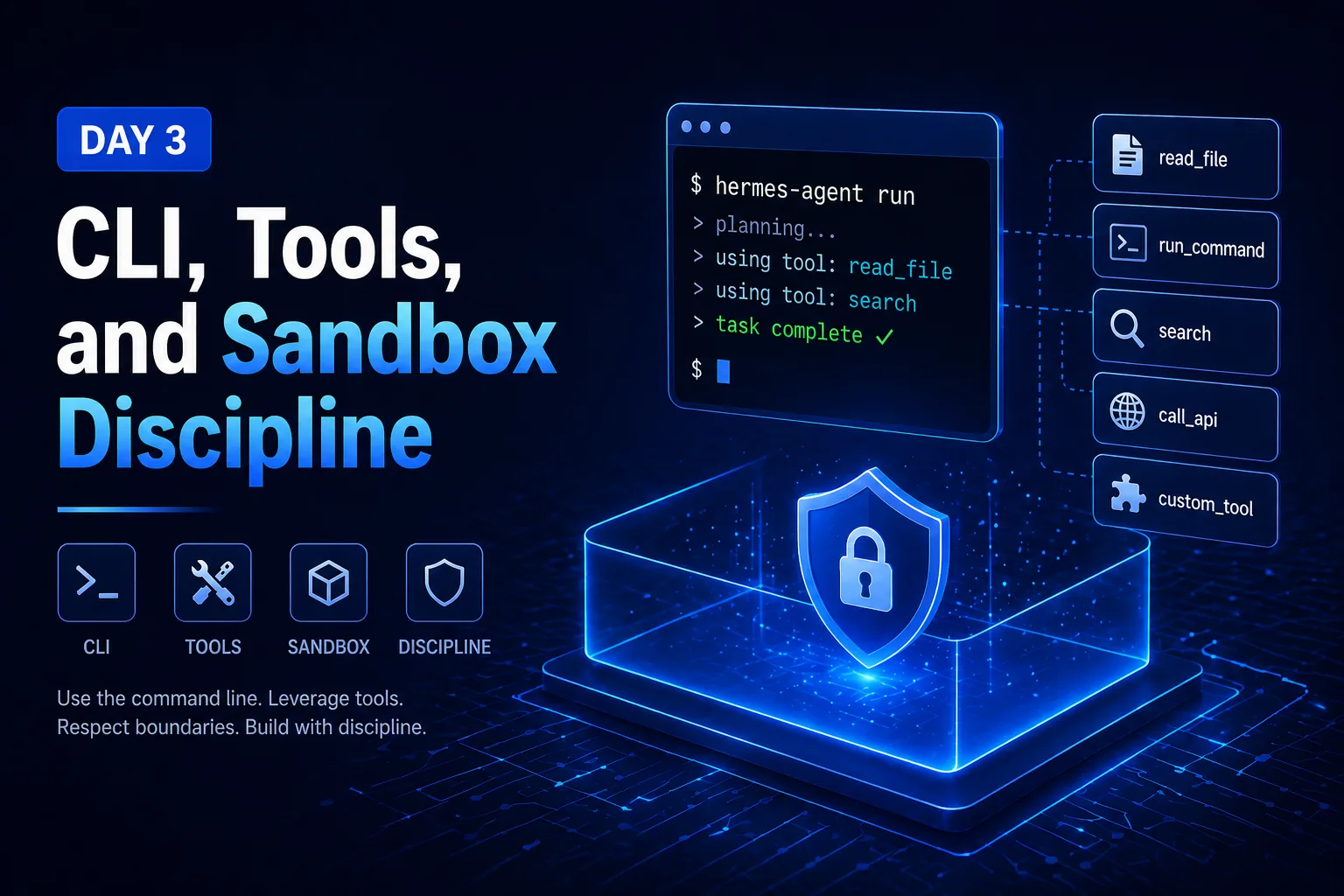
Hermes Agent 6-Hour Crash Course: Hour 3 - Prompts That Produce Reliable Work
Prompt quality has a direct effect on agent quality. Hermes Agent can inspect and act, but it still needs a clear objective. The third hour focuses on prompts that produce reliable work instead of vague exploration.
The reliable prompt shape
A strong prompt usually includes five parts:
- The concrete outcome.
- The relevant area of the project.
- Constraints or things to avoid.
- The expected verification.
- The reporting format.
For example, a weak request says to improve the docs. A stronger request says to add a troubleshooting section to the install page, keep the existing tone, avoid changing unrelated routes, and run the build or explain why it is unnecessary.
Give boundaries
Boundaries help the agent make better decisions. Tell it whether it can edit files, whether it should inspect first, whether it may install dependencies, and whether risky commands require approval. The more operational the task, the more explicit the boundary should be.
Good boundaries do not slow the agent down. They reduce rework. They also protect unrelated parts of the project from accidental churn.
Ask for evidence
Do not ask only for a final answer. Ask for evidence: file paths, command results, failing assumptions, screenshots, or a concise diff summary. Evidence lets you decide whether the result is trustworthy.
For recurring tasks, turn the best prompt into a reusable template. A template should include input fields, expected output, allowed tools, and verification rules.
Hour 3 checkpoint
At the end of this hour, you should have three prompt templates: one for code fixes, one for documentation updates, and one for research or planning. Each template should include success criteria and a verification expectation.